Quick answer: Predictable routines can reduce uncertainty and help some children approach transitions with more confidence. The goal isn't a rigid timetable — it's a flexible, familiar rhythm, built around your child, that you adjust as you learn what helps.
Part of the FamilyDecode Method: Decode → Understand → Plan → Practice → Review
A predictable routine isn't a strict schedule — it's a familiar rhythm a child can rely on.
Most parents know the moment well. It's time to leave the park, switch off the tablet, or come to the table — and what should be a small change turns into a standoff. Transitions like these are some of the hardest parts of family life, and they rarely improve by pushing harder.
A predictable routine can take a lot of the friction out of those moments. Not a rigid, color-coded timetable — those tend to set families up to feel like they've failed by Tuesday — but a familiar rhythm a child can anticipate. This guide walks through why predictability can help, how to build a routine around your particular child, and the small tools that make the hardest moments of the day go more smoothly.
Why predictability can help
Free printableFree Visual Routine Cards
Picture cards that make the day predictable and easy for a child to follow — cut out and rearrange.
✓ Check your inbox — your printable is on its way.
When a child can roughly anticipate what comes next, there's simply less to brace against. The U.S. Centers for Disease Control and Prevention notes that consistent routines and clear expectations help children know what to expect and can help them feel safe and secure. That's a measured claim, and it's the right one: predictable routines can reduce uncertainty and help some children approach transitions with greater confidence.
It helps to hold this loosely. Routines are a support, not a cure, and no two children respond identically. Some settle quickly into a familiar rhythm; others need more warning, more flexibility, or a different kind of cue. The aim is not perfection or control — it's to make the day a little more legible, so more of your energy goes to connection and less to negotiation.
A note on flexibility. A good routine bends. Illness, travel, growth spurts and ordinary bad days will break it, and that's expected. A rhythm you can return to after a disruption is far more useful than a strict schedule you feel you're constantly failing.
The FamilyDecode approach
Before changing a routine, it helps to understand what's actually happening in the hard moment. Our method moves through five steps — Decode → Understand → Plan → Practice → Review — and it starts from the assumption that difficult behavior is usually communication, not defiance.
Decode. Notice the pattern. When does the hard moment happen — a particular time, place, or transition? What tends to come right before it?
Understand. Look for the need underneath: tiredness, hunger, sensory overload, a change that wasn't expected, or a way of communicating that isn't being met. Consider how your child takes in information and lets you know what they need.
Plan. Choose one small, realistic change to try — a warning before transitions, a visual cue, a calmer order to the morning.
Practice. Try it consistently for several days. New rhythms feel clumsy before they feel natural.
Review. Keep what helped, adjust what didn't, and expect to revisit it as your child grows.
This is the part that makes a routine fit a real child rather than a generic template. You're not applying a rulebook — you're observing, then responding.
Building a routine that fits the child
The same schedule can work beautifully for one child and fall apart for another. A routine is far more likely to hold when it's shaped around a few things about your child in particular:
Communication. Some children follow spoken instructions easily; others do better with a picture, a gesture, a demonstration, or a mix. Meet your child in the way they understand best rather than repeating words that aren't landing.
Sensory preferences. Noise, light, textures, crowds and hunger all affect how much a child can cope with. A routine that protects against overload — a quieter spot, a snack before an outing — prevents many hard moments before they start.
Energy and rhythm. Notice when your child is naturally calmer or more capable, and place the demanding parts of the day accordingly where you can.
Family context. The routine has to be one the adults can actually keep. A simple rhythm everyone follows beats an ideal one that only works on good days.
Written inclusively like this, a routine naturally accommodates different communication styles and developmental needs — which is simply what supporting a real child looks like.
Five practical tools
These are the small, low-effort supports that do the most work. You don't need all five — pick the one that fits your hardest moment and start there.
1. Visual schedules
A row of simple pictures showing the order of the day (or of one routine, like the morning) lets a child see what's coming instead of relying on spoken reminders. Visual schedules are widely recommended by child-development and autism organizations because they can help a child anticipate activities, move between them, build independence, and communicate about the day. Our free visual routine cards are made exactly for this.
2. First / then language
“First shoes, then park.” Naming the needed task first and the preferred one second gives a child a clear, doable sequence — and a reason to move through the hard part.
3. Transition warnings
Most children cope better with a change when it doesn't arrive out of nowhere. A simple heads-up — “Two more minutes, then we tidy up” — gives them time to shift gears. A timer or a visual countdown can make the warning concrete.
4. Two acceptable choices
Offering a small, genuine choice within the boundary returns a sense of control: “Do you want to hop to the door like a frog or walk like a bear?” Both answers get you out the door.
5. Consistent language
Using the same short phrase for the same moment (“It's rest time now”) turns your words into a familiar cue. Predictable language is part of a predictable routine.
Real-life examples
Here's how those tools look across the ordinary flash points of a day. Notice that each one is a rhythm you can adapt, not a script to enforce.
Mornings
Keep the order the same each day and make it visible — wake, dress, breakfast, teeth, shoes — with a picture chart the child can follow. If spoken instructions aren't effective, try a visual cue, a gesture, a demonstration, or another communication support that works for your child, rather than taking over the task for them. The goal is a morning that runs on the routine instead of on reminders.
Leaving home
Give a warning before the transition, then a first/then and a choice: “In two minutes we're leaving. First coat, then we can look for the red car on the way. Do you want to carry your bag or shall I?” A predictable leaving-sequence can turn a daily battle into a familiar habit.
School or daycare
Predictability across settings helps. A short, consistent goodbye ritual, and telling your child when you'll be back in terms they understand (“after snack,” not a clock time), can make drop-offs calmer. Where possible, ask carers to keep a similar rhythm so the day hangs together.
Screen time
Screens are easier to end when the ending is predictable. Agree in advance how long and what comes next, give a warning before time is up, and use first/then for what follows: “When the show finishes, it's bath time.” Deciding the rule ahead of the moment keeps you out of a negotiation in it.
Bedtime
A short, consistent wind-down — the same few calm steps in the same order — signals to the body that sleep is coming. Our guide to a bedtime routine by age goes deeper, but the principle is the same: predictable and brief beats elaborate.
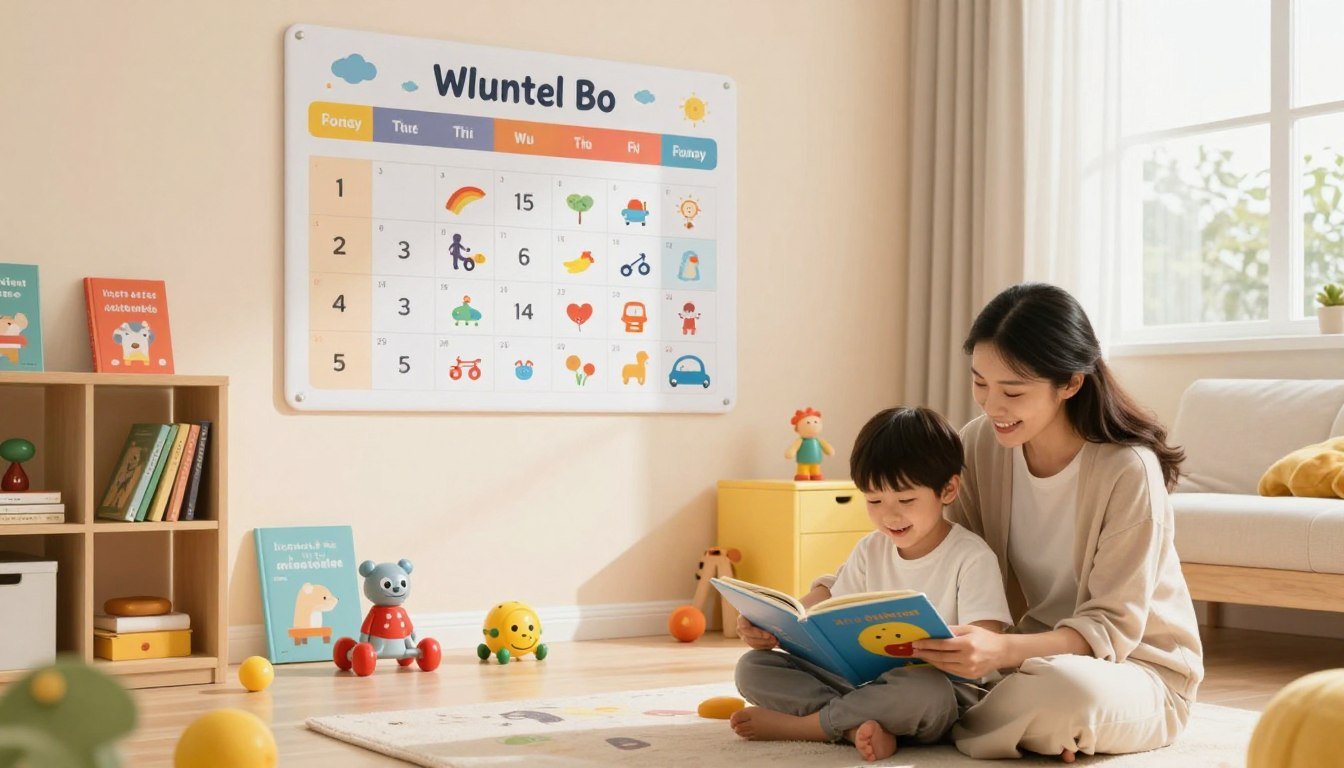
Transitions are often the hardest moments — small warnings and visual cues make them easier.
When plans change
Even the best routine meets days it can't survive — a cancelled outing, a sick parent, a surprise visitor. Change itself isn't the problem; being caught unprepared by it is. A few things help:
Name the change early and simply. “Today is different. We're not going to the park — we're going to Grandma's instead.” Knowing beats guessing.
Use a “change” cue. A special card or phrase that means “the plan is different today” can make the unexpected feel less alarming for children who rely on routine.
Offer the new plan, not just the loss. Replace the missing activity with a clear alternative so there's something to move toward.
Validate the feeling. “You really wanted to go. It's disappointing.” Naming it doesn't undo the change, but it helps a child move through it.
Handled calmly and often enough, changes become part of what a child learns to manage — with your steadiness as the anchor.
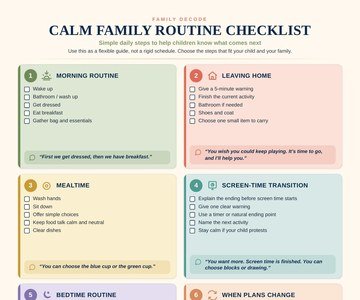
Free printableCalm Family Routine Checklist
Want a simple version you can use at home? Enter your email and we’ll send you the free Calm Family Routine Checklist PDF.
✓ Check your inbox — your printable is on its way.
Review and adjust
A routine is never really finished. What works at two won't fit at four; what suits one child won't suit their sibling. Every few weeks, it's worth a quiet check: which parts are helping, which have become a fight, and what's changed about your child. Adjust one thing at a time, and let go of the idea that a good routine means a perfectly followed one.
Progress here is rarely a straight line, and it doesn't need to be. A routine that bends, returns after a hard day, and grows with your child is doing exactly its job — giving a child enough predictability to feel safe, and enough flexibility to be real.
Frequently asked questions
Do predictable routines really help children?
They can. Consistent routines and clear expectations help children know what to expect and can help some children feel safer and approach transitions with more confidence (a point supported by the CDC). Routines are a support rather than a guarantee, and children respond differently, so it helps to treat them flexibly.
Won't a strict routine make family life more stressful?
It can, which is why the goal is a flexible rhythm rather than a rigid timetable. A routine you can return to after a disruption is far more useful — and less stressful — than a strict schedule you feel you're always failing to keep.
What is a visual schedule and does my child need one?
A visual schedule is a row of simple pictures showing the order of the day or of one routine. It lets a child see what's coming instead of relying on spoken reminders, which can help with transitions, independence and communication. Not every child needs one, but many find it easier than words alone.
How do I handle it when the routine has to change?
Name the change early and simply, offer a clear alternative rather than just the loss, use a consistent “change” cue if your child relies on routine, and validate the feeling. Handled calmly and repeatedly, unexpected changes become something a child learns to manage.
My child ignores spoken instructions in the morning — what should I do?
Try meeting them in the way they understand best: a visual cue, a gesture, a demonstration, or a picture chart of the morning steps, rather than repeating words that aren't landing. Keep the order the same each day so the routine — not constant reminders — carries the morning.
About the author
Mohamed Lachkar is the Founder & Editor of FamilyDecode. He develops practical family guides, planning tools and resources designed to turn recurring family challenges into clearer, repeatable systems.