
Family Daily Schedule: Sample Schedules by Age (+ Free Printable Template)
← Part of our Family Routines Guide
General parenting information, not medical advice. Decode → Plan → Practice → Review.
← Part of our Family Routines Guide
General parenting information, not medical advice. Decode → Plan → Practice → Review.
Most family days don’t fall apart because of one big problem. They fall apart in the gaps: the 20 minutes before school, the hour after pickup, the stretch between dinner and bed where nobody knows what happens next. A simple family daily schedule fills those gaps, so kids know what’s coming and you stop being the family’s alarm clock.
Below you’ll find six sample daily schedules you can copy (school day, toddlers at home, working parents, teens, weekends and summer), the sleep hours each age needs so you can set bedtimes that work, a five-step way to build your own, and a free printable family daily schedule template to put on the fridge.
The American Academy of Pediatrics puts it simply: “Children do best when routines are regular, predictable and consistent”, but the same article warns that a routine that is too rigid leaves no room for choice or flexibility. So aim for a rhythm: a handful of fixed anchors with flexible blocks in between.
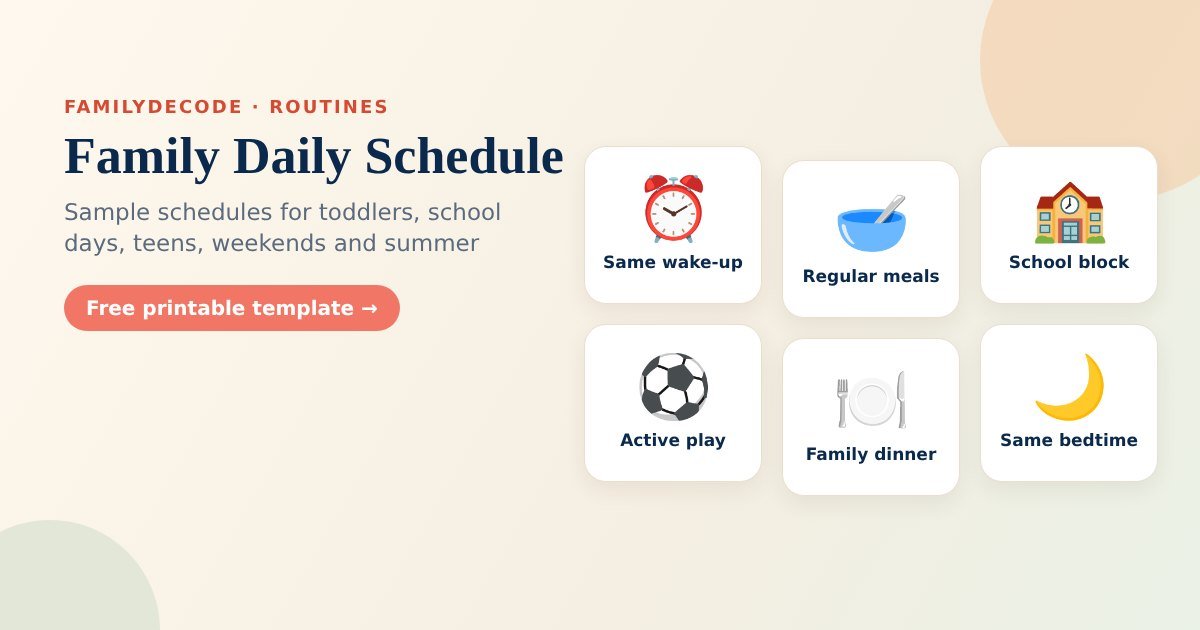
Every family daily schedule needs these six anchors:
The easiest way to build a daily schedule is backwards from bedtime. The American Academy of Sleep Medicine recommends the following total sleep per 24 hours (naps included), and the American Academy of Pediatrics supports these guidelines. The bedtimes below are examples for a family that wakes at 7:00 am.
| Age | Sleep needed (per 24 hours) | Example bedtime for a 7:00 am wake-up |
|---|---|---|
| 4–12 months | 12–16 hours, including naps | Around 6:30–7:30 pm |
| 1–2 years | 11–14 hours, including naps | Around 7:00–8:00 pm |
| 3–5 years | 10–13 hours, including naps | Around 7:00–8:00 pm |
| 6–12 years | 9–12 hours | Around 7:30–8:30 pm |
| 13–18 years | 8–10 hours | Around 9:00–10:30 pm (for a 6:30 am wake-up) |
Sleep ranges: American Academy of Sleep Medicine. Every child is different: adjust within the range and talk to your pediatrician if you’re worried about your child’s sleep.
The AAP also recommends turning off all screens at least an hour before bedtime and keeping them out of children’s bedrooms. Build that hour into your evening block. For age-by-age wind-down ideas, see our bedtime routine by age guide.
This is the classic family daily schedule for a weekday with school-age children. The times are a starting point: slide the whole thing earlier or later to match your school’s start time.
| Time | Kids | Parents |
|---|---|---|
| 6:45 am | Wake up, get dressed, make bed | Coffee, start breakfast |
| 7:10 am | Breakfast together | Breakfast, check the day’s plan |
| 7:30 am | Teeth, shoes, backpack by the door | Pack lunches (or kids do it) |
| 7:45 am | Leave for school | Drop-off / commute |
| 3:15 pm | Pickup, snack, 30 minutes of free play or outdoor time | Pickup or after-care |
| 4:00 pm | Homework or reading | Nearby to help, start dinner |
| 4:45 pm | Activities, sports or more outdoor play | Drive or supervise |
| 6:00 pm | Family dinner (no screens) | Family dinner |
| 6:30 pm | 10-minute tidy-up, chores, free time | Check tomorrow’s calendar |
| 7:30 pm | Bath, pajamas, screens off | Lay out tomorrow’s clothes |
| 7:50 pm | Story, chat, lights out by 8:15 | Your own wind-down time |
Two small habits make this schedule work: prepare the morning the night before (clothes, bags, lunches), and give kids a snack and some free time before homework. The AAP notes that children who have spent a long day in school need time for active play. If afternoons are tough, read our guide to after-school meltdowns and how to set up homework without battles.
Young children need more sleep, more snacks and more movement. Their days are built around meals and naps rather than the clock.
| Time | What happens |
|---|---|
| 7:00 am | Wake up, diaper or potty, get dressed |
| 7:30 am | Breakfast |
| 8:15 am | Free play: blocks, puzzles, pretend play |
| 9:30 am | Morning snack |
| 9:45 am | Outside: park, walk, playground |
| 11:30 am | Lunch |
| 12:15 pm | Quiet routine: story, then nap (1–3 hours) |
| 3:00 pm | Wake up, snack |
| 3:30 pm | Art, music, sensory play or errands together |
| 4:30 pm | Outdoor play or dance party |
| 5:30 pm | Dinner |
| 6:15 pm | Calm play, simple helping jobs |
| 6:45 pm | Bath, pajamas, teeth, books |
| 7:15–7:45 pm | Lights out |
Most children drop the nap somewhere between 3 and 5 years old. When that happens, keep a 45-minute quiet time after lunch (books, audiobooks, puzzles in their room) and move bedtime a little earlier. Struggling with naps? See what to do when your toddler won’t nap.
When both parents work, the day has three short windows at home. The goal is to protect them, not fill them.
| Time | What happens | Who |
|---|---|---|
| 6:30 am | Parents up first (15 minutes of quiet before kids) | Parents |
| 6:45 am | Kids up, dressed, breakfast | Parent A |
| 7:20 am | Bags, shoes, coats; out the door | Parent B |
| 7:40 am | Daycare or preschool drop-off | Parent B |
| 5:15 pm | Pickup, snack in the car | Parent A |
| 5:40 pm | 15 minutes of floor time with no phones | Whoever isn’t cooking |
| 6:00 pm | Simple dinner (planned on Sunday) | Everyone |
| 6:40 pm | Bath, pajamas, books | Take turns |
| 7:30 pm | Lights out | Whoever’s on bedtime |
| 7:45 pm | 10-minute reset: dishes, bags packed, clothes out | Both parents |
A written “who” column stops one parent from holding the whole day in their head. Plan the week’s dinners once on Sunday with our free meal plan generator, and put drop-offs and pickups on a shared weekly family schedule.
Teenagers need 8 to 10 hours of sleep, but early school start times make that hard. Their schedule works best when they own it and you hold just a few non-negotiables: screens out of the bedroom at night, family dinner most nights, and a set time for homework.
| Time | What happens |
|---|---|
| 6:30 am | Wake up (alarm clock, not phone) |
| 6:50 am | Breakfast, pack own bag and lunch |
| 7:20 am | Leave for school |
| 3:00 pm | School ends: sports, club, job or downtime |
| 5:00 pm | Homework block (phone in another room) |
| 6:30 pm | Family dinner, one household job |
| 7:15 pm | Free time, friends, more homework if needed |
| 9:30 pm | Screens off and charging outside the bedroom |
| 10:00 pm | Lights out |
If conversations with your teen have dried up, the car ride and dinner table are the best moments in this schedule. Our guide on what to do when your teen won’t talk has ideas.
Weekends don’t need a timetable, but they do need a shape. Keep wake-up within about an hour of the weekday time and meals at roughly the same times, then plan in loose blocks.
| Block | Saturday | Sunday |
|---|---|---|
| Morning | Slow breakfast, then family chores for 30 minutes | Pancake breakfast, outing or worship |
| Late morning | Sports, activities or the park | Free play or a visit to friends or family |
| Afternoon | Outing, project or playdate (quiet time for little ones) | Quiet time, then a 20-minute family meeting |
| Evening | Family movie or game night | Plan the week, prep bags, early night |
The AAP suggests using weekends for family activities, inviting friends over, and setting aside time for parents too. Sunday evening is the natural moment to review next week’s schedule together.
Without school, days can drift into late mornings and endless screens. A light summer schedule keeps the anchors and leaves lots of room for fun.
| Time | Block |
|---|---|
| 8:00 am | Wake up, breakfast, get dressed |
| 8:45 am | Morning jobs: bed, room tidy, one chore |
| 9:15 am | Outside time before it gets hot |
| 11:00 am | Reading or a learning activity (20–30 minutes) |
| 12:00 pm | Lunch |
| 1:00 pm | Quiet time: books, puzzles, crafts or screens |
| 2:30 pm | Outing, pool, playdate or project |
| 5:30 pm | Dinner |
| 6:30 pm | Evening walk or backyard play |
| 8:00 pm | Wind-down and bedtime (a little later is fine) |
A simple trick for summer is to make each weekday a theme: Monday library, Tuesday park, Wednesday water play, Thursday baking, Friday friends. Kids know what’s coming, and you don’t have to plan from zero every morning.
With a big family, the schedule has to run itself. These ideas help:
Want help building the blocks? Try our free family routine builder for the morning and evening routines, then put the whole week on one page with the weekly family planner.
As an Amazon Associate, FamilyDecode earns from qualifying purchases. See our affiliate disclosure.
A good family daily schedule keeps a few fixed anchors (wake-up, meals, school or work, active play, a connection moment and bedtime) and plans the rest in loose blocks. Start from the sleep your children need, set bedtime, and build the day around it.
List the fixed points of your day, set bedtime from your child’s sleep needs, add meals and snacks, fill the gaps with morning, after-school and evening blocks, then post it where everyone can see it and review it once a week.
It depends on age and wake-up time. With a 7:00 am wake-up, many toddlers and preschoolers go to bed around 7:00 to 8:00 pm, school-age children around 7:30 to 8:30 pm, and teens around 9:00 to 10:30 pm, in line with the AASM sleep ranges.
The American Academy of Sleep Medicine recommends 12 to 16 hours for infants 4 to 12 months, 11 to 14 hours for ages 1 to 2, 10 to 13 hours for ages 3 to 5 (naps included), 9 to 12 hours for ages 6 to 12, and 8 to 10 hours for teens.
Keep the anchors close: wake-up within about an hour of weekdays, meals at similar times and a similar bedtime. The rest of the weekend can be loose blocks for family time, outings and rest.
Keep wake-up, meals and bedtime regular, add a morning job, outdoor time before it gets hot, 20 to 30 minutes of reading, an afternoon quiet time and one outing or project. Themed days make planning easier.
Yes. FamilyDecode’s free printable family daily schedule template has a blank hour-by-hour page with a column for each family member, a sample school-day schedule with sleep hours by age, and a picture routine page for young kids.
Read next: Morning routine for kids · Bedtime routine by age · Creating predictable routines
Free tools: Family routine builder · Weekly family schedule · All free printables