
Holiday Stress With Kids: How to Keep Christmas Calm (Without Canceling the Fun)
← Part of our Emotional Intelligence guide
General parenting information, not medical advice. Decode → Plan → Practice → Review.
← Part of our Emotional Intelligence guide
General parenting information, not medical advice. Decode → Plan → Practice → Review.
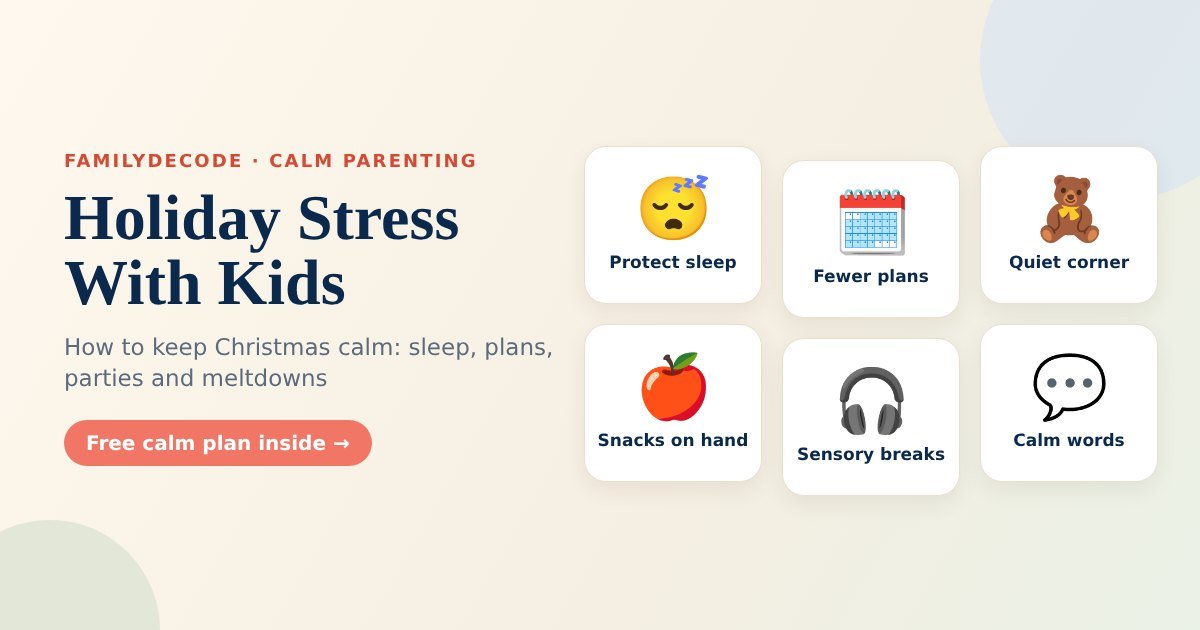
It’s the most wonderful time of the year, and also the one where your sweet four-year-old melts down under the table at Grandma’s, the toddler skips two naps in a row, and you find yourself wrapping presents at midnight wondering why everyone is so cranky. Holiday stress with kids is real, and it isn’t a sign you’re doing Christmas wrong. It’s what happens when late nights, crowded rooms, sugar-filled schedules and big expectations land on small nervous systems, and on tired parents.
The good news: a calm Christmas doesn’t mean canceling the fun. It means planning the season around what children can actually handle. This guide shows you how, with a simple plan for December, signs of overwhelm by age, what to do in the middle of a holiday meltdown, how to handle relatives and travel, and how to look after your own stress too. There’s a free printable Calm Holiday Plan along the way.
For adults, December stress is mostly about money, time and family. In a 2023 survey for the American Psychological Association, 89% of U.S. adults said worries such as money, missing loved ones and family conflict cause them stress during the holidays. In the American Psychiatric Association’s 2025 Healthy Minds Poll, 41% of adults expected more holiday stress than the year before, with grief, gift costs and difficult family dynamics topping the list.
Children feel the season differently, but just as strongly:
Most holiday meltdowns aren’t about the toy or the itchy sweater. They’re the last drop in a cup that’s been filling all day. Our guide to why behavior is communication explains what’s going on underneath.
| Age | Signs of holiday overload | What helps most |
|---|---|---|
| Toddlers (1–3) | Clinginess, crying over small things, refusing to eat or sleep, hitting or biting, “wild” running in crowded rooms | Naps on schedule, a quiet room, the comfort item, short visits, your arms |
| Preschoolers (3–5) | Big tantrums, silliness that won’t stop, whining, “no” to everything, trouble falling asleep | A preview of the day, choices between two options, snack breaks, a calm corner |
| School-age (6–12) | Arguing with siblings, rudeness, tears over gifts, stomachaches, wanting screens all day | One-on-one time, some say in the plans, physical activity, predictable bedtime |
| Teens | Withdrawing to their room, irritability, staying up very late, conflict about family obligations | Respecting downtime, negotiating which events they join, honest conversations |
When you spot the signs early, you can step in with food, rest or quiet before the meltdown arrives. For deeper help with big feelings, see our guides to emotional regulation for kids and toddler emotional regulation.
You don’t need all ten. Pick the three or four that fit your family and put them on the calendar before December fills up.
Sit down together in November and sort every invitation and idea into three lists: must-do, nice if there’s energy, and skip this year. Keep the traditions your family truly loves (our list of 50 family Christmas traditions can help you choose) and let the rest go without guilt.
For young children, one big outing, party or event a day is plenty. Two in one day, plus shopping, is a recipe for a 5 p.m. meltdown. Leave at least one day a week completely empty: pajamas, puzzles, nowhere to be.
Tired children have less patience, less flexibility and more meltdowns. Keep bedtime within about 30 minutes of normal, protect naps on big days, and plan late events for the night before a slow morning. These are the CDC’s recommended hours of sleep per 24 hours:
| Age | Recommended sleep per 24 hours |
|---|---|
| Toddlers, 1–2 years | 11–14 hours, including naps |
| Preschoolers, 3–5 years | 10–13 hours, including naps |
| School-age, 6–12 years | 9–12 hours |
| Teens, 13–17 years | 8–10 hours |
Our bedtime routine by age guide helps you get back on track, and a portable white noise machine makes sleep easier at relatives’ houses and hotels.
Hunger is behind more holiday meltdowns than most parents realize. Big family dinners are often served late, so give children a filling snack beforehand and keep water and simple snacks in your bag. Don’t worry if your child eats only bread rolls at the holiday table; our guide to toddler picky eating explains why pressure backfires.
Even on busy days, plan 20 to 30 minutes of low-key time: books on the couch, a bath, a puzzle, an audiobook. Quiet time isn’t a punishment; it’s a refill. The AAP suggests keeping household routines the same where you can, and a daily quiet hour is one of the easiest routines to protect.
Before each party or visit, tell your child what will happen: who will be there, what you’ll do, what the rules are, and when you’ll leave. “We’re going to Aunt Sara’s. There will be lots of cousins and it might be loud. We’ll eat dinner, open one present each, and leave after dessert.” Children cope much better with a day they can picture.
Fill a small bag with a favorite snack, water, a small book or quiet toy, the comfort item, spare clothes and wipes. For children sensitive to noise, kids’ noise-reducing ear muffs make loud parties and fireworks easier. A few quiet fidget toys or a reusable sticker book buy precious minutes during long dinners.
When you arrive somewhere new, find a calm place together: a spare bedroom, the car, a porch. Agree on a secret signal your child can use when they need a break. Taking a break isn’t giving in; it’s teaching your child to notice their own limits.
Screens can be a lifesaver on travel days and a source of battles on long holidays at home. Decide in advance when screens are part of the plan (the car, a quiet hour, a family movie night) and when they aren’t. Our screen time by age guide has realistic limits, and the Screen Agreement Generator makes a holiday version in minutes.
A mountain of presents in one morning is a lot for small children. Open gifts slowly, one at a time and taking turns, play with new toys before opening more, and quietly put some aside to bring out in January or February. Fewer gifts at once means more joy per gift.
Even with the best plan, meltdowns happen, often in public and usually at the worst moment. Here is a calm sequence that works for most young children:
Calm words to keep in your pocket:
For a deeper toolkit, read our guides on how to handle toddler meltdowns, calm responses to tantrums and how to stop yelling. Our Big Feelings emotional regulation toolkit puts calm-down tools, feelings cards and scripts in one printable kit, and the free Calm-Down Plan is a good place to start.
Some holiday moments go wrong for almost every family. Here is what is usually behind them, and what to try first.
| The moment | What’s usually going on | Try this |
|---|---|---|
| Meltdown in a busy store | Noise, crowds, waiting, a skipped snack | Shop alone or online when you can; go early in the day; give your child a job like holding the list |
| Tears on Santa’s lap | A stranger in a costume is scary for many young children | Never force it. A wave from a distance or a photo standing next to Santa counts |
| Wild after a party | Overtired and overstimulated | Bath, dim lights, a familiar story, the usual bedtime words. Skip the debrief until morning |
| Can’t sleep on Christmas Eve | Excitement, anticipation, a later dinner | Keep the same bedtime steps, add an audiobook, and set a “no getting up before” clock or light |
| Disappointed with a gift | High expectations and big feelings | Name it (“You hoped for something else”), then practice saying thank you before the next visit |
| Fighting over new toys | Tired kids, new things, shared space | Put a few special gifts away before guests arrive; use a timer for turns |
| Refusing the holiday dinner | Late meal, unfamiliar food, too much going on | A filling snack beforehand and one familiar food on the plate; no pressure to try |
| Meltdown in the car | Long sitting, boredom, motion, hunger | Stop every two hours, snacks within reach, a new small activity for each leg |
Holidays bring well-meaning advice: “He should be eating that,” “In my day, kids didn’t talk back.” Agree with your partner beforehand on how you’ll respond, then keep it short and kind: “Thanks, we’ve got it.” Your child needs to see you calm far more than they need you to win the argument.
Many children feel shy with relatives they rarely see. Instead of insisting on hugs and kisses, offer choices: a wave, a high-five, a fist bump or a drawing. Tell grandparents ahead of time, so nobody feels rejected.
New toys, tired kids and tight spaces mean conflict. Let children put a few special new gifts away before cousins arrive, set a timer for turns, and step in early when voices rise. Our guide to helping siblings get along has scripts that work with cousins too, and the Sibling Fight Repair Kit helps children make up after a fight.
Long, late meals are hard for young children. Feed them a snack beforehand, let little ones leave the table when they’ve finished, and bring a small activity for the wait. One familiar food on their plate makes new foods less scary.
Travel days stretch everyone’s patience. Travel at nap time or early in the morning when you can, pack snacks and new small activities, and plan a slow first day after you arrive. Heading to a Thanksgiving dinner first? See our plan for Thanksgiving with toddlers. Our guides to flying with a toddler, road trips with toddlers and helping a toddler sleep in a hotel cover the details. A car-seat travel tray and a few reusable sticker pads make long journeys easier.
Children borrow their calm from the adults around them. Protecting your own energy is part of protecting theirs.
For some families, December brings grief, a first Christmas after divorce, money worries or a family member far away. The AAP encourages parents to be sensitive to feelings of loss, sadness or isolation and to ask for help. Be honest with children in words they understand, keep one or two familiar traditions, and make space for sadness alongside the celebrations. Our guide to preparing kids for big changes has gentle wording for separation, moves and new babies.
If your child’s worries, sleep problems or mood changes last for weeks or get in the way of daily life, talk to your pediatrician or a mental health professional. If you are struggling yourself, reach out to your doctor or someone you trust; you don’t have to carry it alone.
A few things that make busy days calmer: kids’ ear muffs for loud parties, a visual timer for turns and leaving time, a portable white noise machine for sleep away from home, a calm-down book such as The Color Monster, quiet fidget toys and a spill-proof snack cup for the calm bag.
As an Amazon Associate, FamilyDecode earns from qualifying purchases. See our affiliate disclosure.
Most holiday meltdowns come from overload: less sleep, broken routines, late meals, noisy crowded rooms, lots of waiting and lots of excitement. Children have fewer skills than adults to manage all of that, so the stress comes out as tears, tantrums or silliness.
Plan one big activity a day, keep naps and bedtime close to normal, offer snacks on schedule, prepare your toddler before each event, bring a calm bag with the comfort item, and find a quiet spot wherever you go. Leave early when you see the first signs of overload.
Move your child somewhere quieter, stay close, use very few words, name the feeling and help their body calm down with a hug, water or slow breaths. Keep the limit kindly, and talk about what happened later when everyone is calm. You don’t owe the room an explanation.
Keep the main anchors of the routine, especially sleep, meals and a daily quiet time, as close to normal as you can. The American Academy of Pediatrics recommends keeping household routines and your child’s usual sleep and mealtime schedules when you can.
Do fewer things, share the to-do list with your partner, set a gift budget, lower the bar on perfection and plan real breaks for yourself. Children feel calmer when the adults around them are calmer.
Yes. Leaving before your child falls apart is a kind choice, not a failure. Tell hosts in advance that you may leave early, and choose the events that matter most to your family.
If worries, sleep problems, mood changes or behavior problems last for weeks after the holidays or interfere with daily life, talk with your pediatrician or a mental health professional.
Read next: 50 family Christmas traditions · How to handle toddler meltdowns · The calm parenting guide
Related reading: Bedtime routine by age · Toddler separation anxiety · The weekly family meeting
Traveling for the holidays? Christmas in the Smoky Mountains with toddlers · Flying with a toddler
Put it into practice: grab the free Calm Holiday Plan above, or browse the free printables library.