
Best Screen Time Agreement Printables for Tweens and Teens: Top Picks and Why They Work
← Part of our Screen Time by Age guide
General parenting information, not medical advice. Decode → Plan → Practice → Review.
← Part of our Screen Time by Age guide
General parenting information, not medical advice. Decode → Plan → Practice → Review.
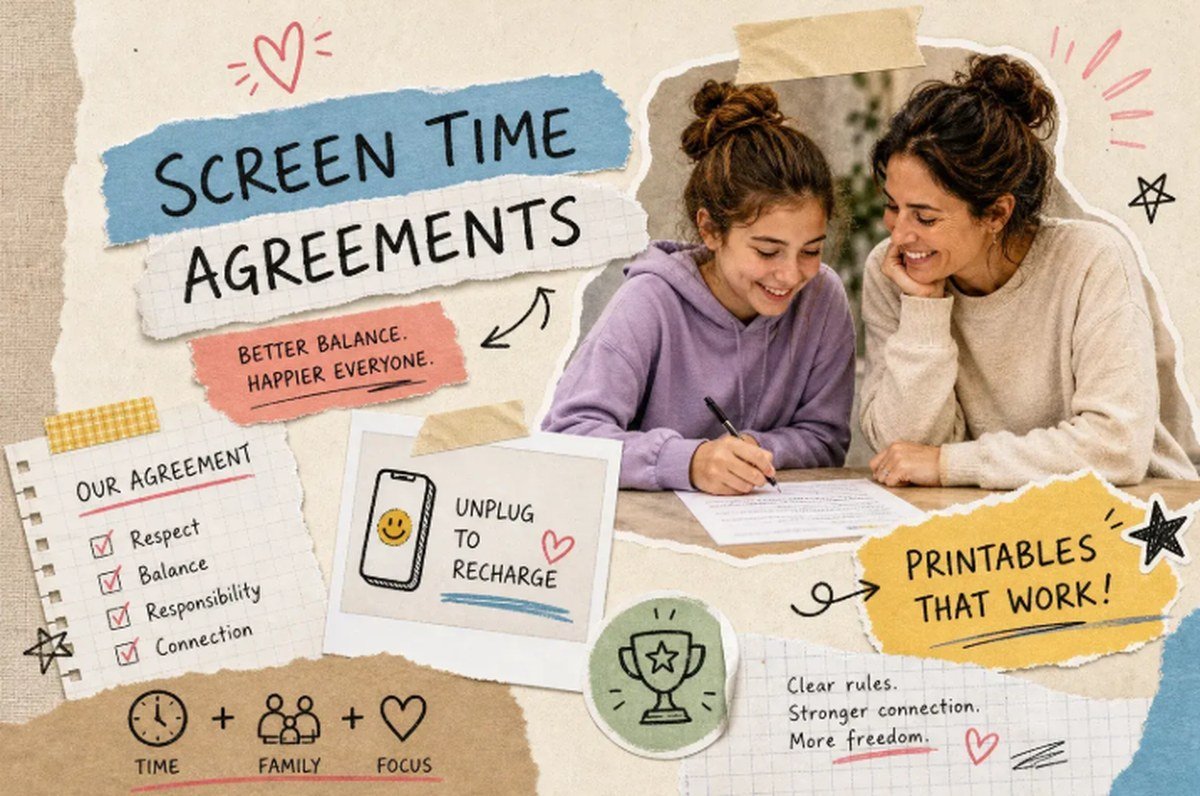
Among the most highly regarded free screen time agreement printables for tweens and teens is the SmartSocial Family Media Agreement, available as a PDF, condensed PDF, and editable Google Doc. For paid options, the highest-reviewed choices on Etsy are the Kids Cellphone Contract (around 3,600 reviews), the Screen Time Family Contract Canva Template (around 2,000 reviews), and the First Phone & Family Device Agreement Kit for households that want age-specific contracts plus a fridge-ready poster.
A printed, signed agreement tends to outperform a verbal rule because it removes the daily negotiation. The rule is on paper, everyone signed it, and nobody has to reconstruct what was actually decided. The right template, though, depends on your child’s age and how your family makes decisions together. Tweens need concrete boundaries guided by parents; teens need room to co-write the terms. That distinction shapes everything from the language to the consequence structure. FamilyDecode is the resource hub for the system behind the agreement, turning a one-time signing session into a household routine that actually holds.
Free options give flexibility and cost nothing; paid options tend to offer more structure, age-specific language, and design quality. Think of this section as a reference guide: start with format and age range, then use review counts as a quality filter.
The SmartSocial Family Media Agreement is a strong free starting point. It covers social media expectations alongside general device rules in a single document, and the editable Google Doc version lets you change wording before you print. The PrintableContracts Screen Time Contract is a bare-bones editable .DOC file that works in Microsoft Word or Google Docs. It suits families who want to write most of the language themselves rather than adapt someone else’s framework. Both free options require a willingness to customize wording to match your child’s age and situation; they are not ready to sign off the shelf.
Want one that is ready to sign? Our free Screen Time Agreement Kit has separate tween and teen agreements, and our one-page Family Screen-Time Agreement works for younger kids.
The table below matches each printable to its best use case and format, with review counts as the clearest available popularity signal from Etsy. Counts reflect a 2026 snapshot of each listing.
| Printable | Best for | Format | Review signal |
|---|---|---|---|
| Kids Cellphone Contract (Etsy) | Tweens and teens, first phone | PDF + DOCX | ~3,600 reviews |
| Screen Time Family Contract Canva Template (Etsy) | Editable design, household tech rules | Canva + PDF | ~2,000 reviews |
| Kid/Teen Cell Phone Contract Printable (Etsy) | Phone ownership and usage limits | PDF + DOCX | ~1,400 reviews |
| First Phone & Family Device Agreement Kit (Etsy) | Multi-age households, poster included | 10-page PDF + Word + poster | Kit format |
| PerfectlyPrintly Family Tech Rules (Etsy) | Polished design, reliable seller | 4.9/5, Star Seller, 1,500+ sales |
Match your child’s age range and your preferred format first, then use the review count as a quality filter rather than an absolute ranking. PerfectlyPrintly is the strongest pick on seller reliability; the Kids Cellphone Contract leads on sheer user engagement.
Downloading the wrong version for your child’s age is the most common setup mistake. The language, consequence structure, and decision-making model differ significantly between the two, and a mismatch creates resistance before the agreement is even signed.
Tween agreements work best with short sentences, “do/don’t” prompts, approved-app lists, and simple “If…, then…” consequence formats. Privacy and safety sections should teach protective rules: no sharing addresses, passwords, or images; ask an adult before clicking or downloading. Visuals and checkboxes help. The parent remains the primary decision-maker; the child practices following a routine rather than co-writing policy. A strong tween template addresses questions like:
Teen agreements need open fields for goals, exceptions, privacy expectations, monitoring procedures, appeal processes, and review dates. Language should be respectful and non-childish. Consequence structures work better when they are progressive and negotiated: expectation, consequence, repair step, conditions for restoring privileges. The best teen templates position the teen as a co-author, not a recipient of rules. That framing is what actually produces follow-through. A strong teen template addresses questions like:
If your teen shuts down when you bring up phones, start with our guide on what to do when a teenager won’t talk, or open the conversation with a few of our 50 screen time questions.
The American Academy of Pediatrics does not prescribe a universal daily screen time limit for tweens and teens. Its framework focuses on balance, content quality, co-use, sleep protection, and ongoing communication. Those five areas give you the organizing structure for any solid family tech agreement.
Devices should charge outside bedrooms overnight, and recreational screens should end before a defined pre-bed window. One hour before sleep is a commonly cited pediatric benchmark. Screen-free times during meals and homework greatly reduce daily negotiation because the rule is spatial or temporal rather than subjective. The AAP also recommends protecting roughly 60 minutes of daily physical activity for school-age children and teens; that benchmark belongs in the agreement too. Screen-free zones and times are the most enforceable terms you can write, so lead with them.
Every solid digital family contract should include clear privacy rules. That means no sharing passwords, identifying information, or images without a plan, keeping privacy settings enabled, and restricting location sharing. Address content expectations directly, including disabling autoplay and infinite scroll where feasible. One of the most important clauses in any family tech agreement is the safety exception: a child can report something upsetting online without automatically losing the device. Without that clause, children often hide problems to protect their access. Define consequence language that is proportional, temporary, and unrelated to shaming, and always include a review date so the agreement is explicitly framed as revisable rather than permanent.
Conflict at implementation almost always traces back to a meeting that felt like a lecture rather than a co-writing session. The goal is a 20-to-45-minute family meeting that ends with a signed agreement and a review date on the calendar.
Print one blank agreement per person. Decide on two or three non-negotiables privately before the meeting, for example, no devices during meals, screens off before bed, charging outside bedrooms. Bring evidence of the actual problem in observable terms (“Bedtime has turned into repeated arguments”) rather than labels. Prepare to include adult accountability from the start: parents follow the same meal and bedtime rules the agreement sets for the rest of the household. That step alone signals to children that this is a shared plan, not a one-sided policy.
Open with reassurance, not a warning: “This is not a punishment meeting. We use screens, we enjoy them, and we’re here because we want them to fit better with sleep and school.” Start by asking what screens help each person do, so the conversation begins with shared goals rather than restrictions. Identify friction without blame using observable behavior rather than labels. Let children propose solutions first; they often suggest more workable ideas when they have genuine input. Co-write three to five rules together, covering when, where, what, and what happens next. Agree on transition warnings, a 10-minute alert, then a 2-minute alert, and on a proportional, specific consequence for broken rules.
Before closing, use a simple buy-in check: ask each person to rate their confidence on a scale of 1 to 10. If someone says 5, ask what adjustment would move them one point higher. Frame the agreement as a two-week experiment rather than a permanent policy. That framing alone tends to produce more cooperation because it signals the plan is revisable, not final.
For a full meeting structure you can reuse every week, see our family meetings guide. The free kit below includes this exact agenda and the 1-to-10 buy-in scale on one printable page.
A screen time contract is a snapshot. It captures what the family agreed on one afternoon. Without a system behind it, the agreement fades within weeks, usually around the first busy stretch of school or the first conflict over a broken rule.
FamilyDecode’s free printable library includes 100+ resources: routine charts, visual reminders, and structured planners built to support family agreements well past the initial meeting. The age-specific tools, covering toddlers through teens, mean parents do not have to adapt a generic chart to fit a twelve-year-old versus a fifteen-year-old. The practical articles also cover scenarios like screen shutdowns, sibling disputes over shared devices, and bedtime resistance, giving parents a reference point when the agreement is being tested in real life.
FamilyDecode’s four-step structured method ends with a weekly family review. For screen time agreements specifically, this review is where the signed contract stays alive: parents and children check in on what is working, what is not, and what adjustments are fair. Without a scheduled review, agreements are commonly abandoned within a month. With one, the agreement becomes a living plan rather than a document that gets ignored after the first disagreement. FamilyDecode’s planners build that review into the family’s weekly rhythm so it does not need to be reinvented each time the contract gets tested.
For a free printable screen time contract, SmartSocial’s Family Media Agreement is a strong starting point: flexible, well-structured, and available in a format you can edit before printing. For paid options, the Kids Cellphone Contract and the Screen Time Family Contract Canva Template lead on user engagement, while PerfectlyPrintly is the most reliable seller choice by rating and sales history. The First Phone & Family Device Agreement Kit is the right pick for multi-age households that want a poster on the wall alongside age-specific contracts.
The decision logic is straightforward: match the template to your child’s age range, choose an editable format if you need to customize the language, and schedule the first review date before the meeting ends. A screen time agreement that sits in a drawer after week two is not a system. It is a conversation that did not get a follow-up. The printable gets the conversation started; the structure keeps it going.
FamilyDecode’s free printable library is the place to build that structure. The routine charts, planners, and weekly review tools give the agreement somewhere to live after the first disagreement, and they are ready to use without professional training or a large time investment. Browse the library at FamilyDecode and pair the right template with a system that actually sticks.
Yes, many of the top printables are editable so you can change wording before you print. The SmartSocial Family Media Agreement is available as an editable Google Doc, the Screen Time Family Contract is a Canva template, and several Etsy listings include PDF and DOCX formats for customization.
We recommend a weekly family review as the most effective cadence. That weekly check-in is where the agreement stays alive, helping everyone assess what is working, what needs adjustment, and preventing the contract from being abandoned within a month.
Yes, a printed, signed agreement tends to outperform a verbal rule because it removes daily negotiation. The rule is on paper, everyone signed it, and nobody has to reconstruct what was decided, which reduces friction at enforcement time.
Read next: Screen time by age · How to write a family media agreement · 50 screen time questions · Screen time statistics 2026
Free printables: Screen Time Agreement Kit · One-page screen-time agreement · All free printables